
Iran’s MuddyWater targets critical infrastructure in Israel and Egypt, masquerades as Snake game – ESET Research discovers
Created: 2025-12-04 03:39:39
- ESET researchers have identified new MuddyWater (Iran-aligned cyberespionage group) activity primarily targeting critical infrastructure organizations in Israel, with one confirmed target in Egypt.
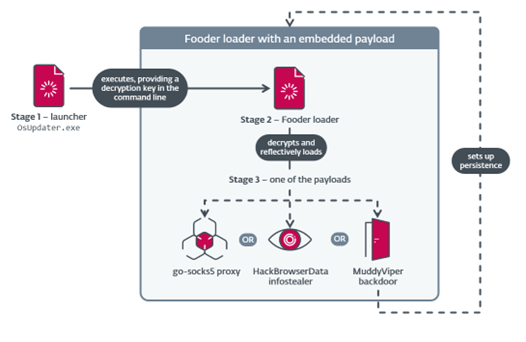
- The group used more advanced techniques to deploy MuddyViper, a new backdoor, by using a loader (Fooder) that reflectively loads it into memory and executes it.
- ESET provides technical analyses of the tools used in this campaign.
MONTREAL, BRATISLAVA — December 2, 2025 — ESET researchers have identified new MuddyWater activity primarily targeting organizations in Israel, with one confirmed target in Egypt. The victims in Israel were in the technology, engineering, manufacturing, local government, and educational sectors. MuddyWater, also referred to as Mango Sandstorm or TA450, is an Iran-aligned cyberespionage group known for its persistent targeting of government and critical infrastructure sectors, often leveraging custom malware and publicly available tools, and has links to the Ministry of Intelligence and National Security of Iran. In this campaign, the attackers deployed a set of previously undocumented, custom tools with the objective of improving defense evasion and persistence. New backdoor MuddyViper enables the attackers to collect system information, execute files and shell commands, transfer files, and exfiltrate Windows login credentials and browser data. The campaign leverages additional credential stealers. Among these tools is Fooder, a custom loader that masquerades as the classic Snake game.
In this campaign, initial access is typically achieved through spearphishing emails, often containing PDF attachments that link to installers for remote monitoring and management (RMM) software hosted on free file-sharing platforms such as OneHub, Egnyte, or Mega. These links lead to the download of tools including Atera, Level, PDQ, and SimpleHelp. Among the tools deployed by MuddyWater operators is also the VAX One backdoor, named after the legitimate software which it impersonates: Veeam, AnyDesk, Xerox, and the OneDrive updater service.
The group’s continued reliance on this familiar playbook makes its activity relatively easy to detect and block. However, in this case, the group also used more advanced techniques to deploy MuddyViper, a new backdoor, by using a loader (Fooder) that reflectively loads MuddyViper into memory and executes it. Several versions of Fooder masquerade as the classic Snake game, hence the designation, MuddyViper. Another notable characteristic of Fooder is its frequent use of a custom delay function that implements the core logic of the Snake game, combined with “Sleep” API calls. These features are intended to delay execution in an attempt to hide malicious behavior from automated analysis systems. Additionally, MuddyWater developers adopted CNG, the next-generation Windows cryptographic API, which is unique for Iran-aligned groups and somewhat atypical across the broader threat landscape. During this campaign, the operators deliberately avoided hands-on-keyboard interactive sessions, which is a historically noisy technique often characterized by mistyped commands. Thus, while some components remain noisy and easily detected, as is typical for MuddyWater, overall this campaign shows signs of technical evolution – increased precision, strategic targeting, and a more advanced toolset.
The post-compromise toolset also includes multiple credential stealers: CE-Notes, which targets Chromium-based browsers; LP-Notes, which stages and verifies stolen credentials; and Blub, which steals login data from Chrome, Edge, Firefox, and Opera browsers.
MuddyWater was first introduced to the public in 2017 by Unit 42, whose description of the group’s activity is consistent with ESET’s profiling – a focus on cyberespionage, the use of malicious documents as attachments designed to prompt users to enable macros and bypass security controls, and primarily targeting entities located in the Middle East.
Notable past activities include Operation Quicksand (2020), a cyberespionage campaign targeting Israeli government entities and telecommunications organizations, which exemplifies the group’s evolution from basic phishing tactics to more advanced, multistage operations; and a campaign targeting political groups and organizations in Türkiye, demonstrating the group’s geopolitical focus, its ability to adapt social engineering tactics to local contexts, and reliance on modular malware and flexible C&C infrastructure.
ESET has documented multiple campaigns attributed to MuddyWater that highlight the group’s evolving toolset and shifting operational focus. In March and April 2023, MuddyWater targeted an unidentified victim in Saudi Arabia, and the group conducted a campaign in January and February 2025 that was notable for its operational overlap with Lyceum (an OilRig subgroup). This cooperation suggests that MuddyWater may be acting as an initial access broker for other Iran-aligned groups.
For a more detailed analysis of the latest MuddyWater campaign, check out the latest ESET Research blogpost “MuddyWater: Snakes by the riverbank” on WeLiveSecurity.com. Make sure to follow ESET Research on Twitter (today known as X), BlueSky, and Mastodon for the latest news from ESET Research.
Overview of Fooder loading MuddyViper or other supported payloads
About ESET
ESET develops software solutions that deliver instant, comprehensive protection against evolving computer security threats. ESET pioneered and continues to lead the industry in proactive threat detection. ESET NOD32 Antivirus, its flagship product, consistently achieves the highest accolades in all types of comparative testing and is the foundational product that builds out the ESET product line to include ESET Smart Security. ESET Smart Security is an integrated antivirus, antispyware, antispam and personal firewall solution that combines accuracy, speed and an extremely small system footprint to create the most effective security solution in the industry. Both products have an extremely efficient code base that eliminates the unnecessary large size found in some solutions. This means faster scanning that doesn’t slow down computers or networks. Sold in more than 160 countries, ESET has worldwide production headquarters in Bratislava, SK and worldwide distribution headquarters in San Diego, U.S. ESET also has offices in Bristol, U.K.; Buenos Aires, AR; Prague, CZ; and is globally represented by an extensive partner network. For more information, visit our local office at https://eset.version-2.sg.
About Version 2 Limited
Version 2 Limited is one of the most dynamic IT companies in Asia. The Company develops and distributes IT products for Internet and IP-based networks, including communication systems, Internet software, security, network, and media products. Through an extensive network of channels, point of sales, resellers, and partnership companies, Version 2 Limited offers quality products and services which are highly acclaimed in the market. Its customers cover a wide spectrum which includes Global 1000 enterprises, regional listed companies, public utilities, Government, a vast number of successful SMEs, and consumers in various Asian cities. For more information, please visit https://www.version-2.com.sg/ or call (65) 6296-4268.

 Join ESET at Facebook